Earthworkers
by Nele Bergmans // January 2023
When reflecting on the art that deeply touches me, or that I’m drawn to, I recognise a group of artists that work with natural materials. More specifically, they use nature itself. Their work is not necessarily about the landscape, but it is quite often related to it. The works that attract me the most are the ones that are just a tiny gesture, a re-arrangement of things, that relate to a very primal experience of bigger forces operating in the natural world. In their small gestures, I often experience the largeness of life.
I will draw a parallel to the works of four artists in this essay. It’s a bit unfortunate that they are all white, male and from Europe. But, we have to start somewhere, and not acknowledging valuable references on the basis of their gender and background is sexist and discriminative in all directions.
Richard Long and the human interaction with landscape
When reading about the work of Richard Long, I came across the term ‘Earthworkers’ 1. It’s a term for artists working in the late 1960’s in the ‘Land Art’ movement. This largely American movement stems from conceptualism and minimalism and is sometimes also referred to as ‘Earth Art’. 2 I previously only knew the term Land Art and associated it with large scale installations in the landscape, often abstract and conceptual. The term ‘Earth Art’ relates the movement much more to nature, mother earth, and allows for more human connection. Since I use stone quite often, I was curious if there is also a movement in art called ‘stone art’. But on googling, it basically takes you to restauration pages. I’m not so interested in the large scale conceptual works, but in the smaller, more intimate, more ephemeral works.
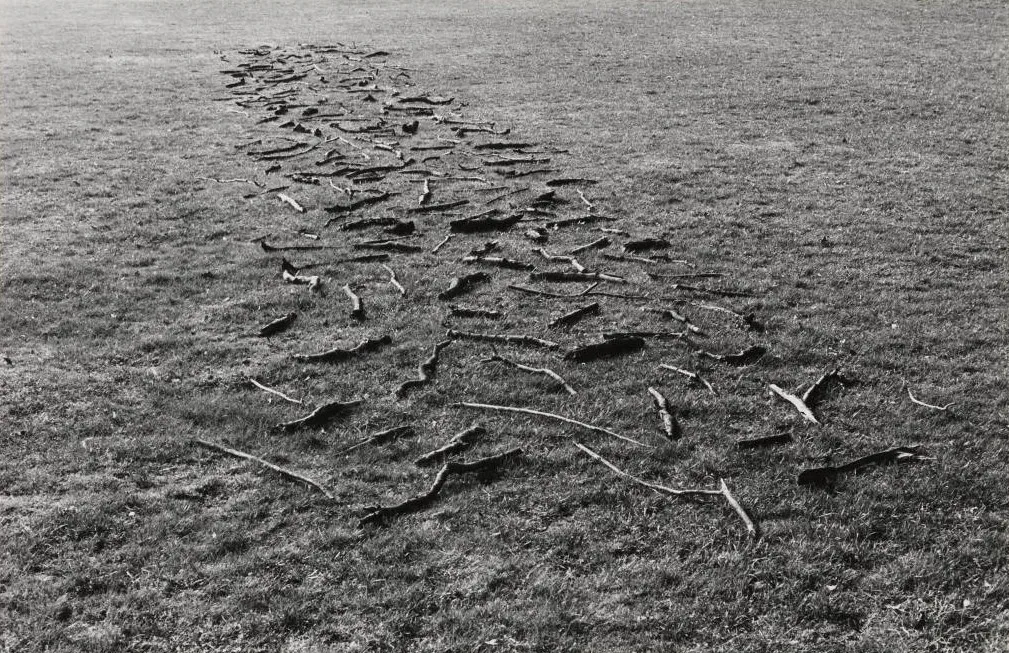
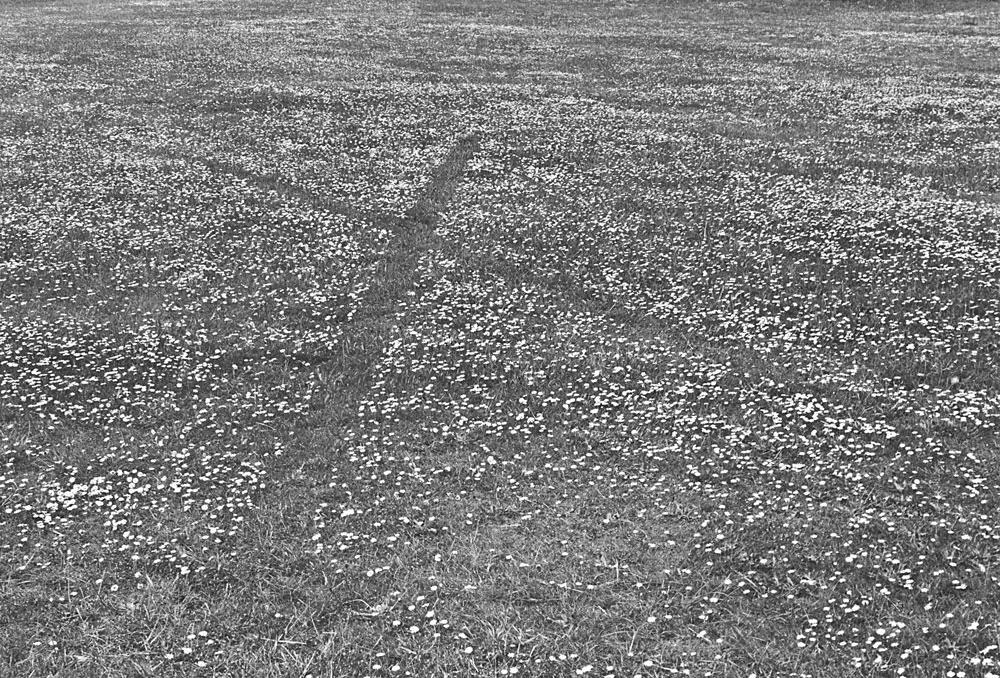
Often, with good artists, their first works already contain in very condensed version all the elements they will explore in their future practise. In Richard Long’s case, this is certainly true. The early works England 1968 (Fig 01) and Sticks in Somerset (Fig 02) are very revealing. He works with landscapes he truly knows (the meadow full of daisies, a field of grass on a forest edge) and is able to pick out one element in this landscape that is intrinsically linked to this specific place, which he then reveals by twisting their arrangement just a tiny bit, through very normal gestures (walking, picking up, throwing), arranging them in the most basic shapes (a circle, a line).
Personally, I’m quite drawn to these very simple geometric shapes. I find them very effective in their universality and distinctness. As Charles Harrison writes: “The evident and uncomplicated geometrically of the form asserts its origin in human activity and thus prepares the spectator for consideration of the ‘interaction’ between artist andenvironment.”3 He also says Long works with the feeling of the place “as being the stimulus toa search for the materials which would most effectively embody that sensation of the place in an appropriate configuration”. In a written statement by Long,he refers to his work as ‘A portrait of the artist touching the earth.’ 4

I must admit, on first discovering his work, I was very much drawn to the formal aspects of the work. The photograph of the work in nature. I didn’t really get the whole concept of walking and wrote the following in my notebook:
“What do I think of his ‘conceptual’ link to time and space? For me, I’m very much drawn to the formal qualities of the work. The extra explanation, although I can see it gives the work validation or ‘depth’, is an additional quality and may for some people really make the work. But for me, if the spiral he walks with muddy boots in a gallery is the exact same length of one of his real walks, I don’t care. I also wonder, since the walks are so important, why is Long only engaging with a materiality found on his walks? I miss the feelings of cold air in winter, the blinding of the sun when low to the horizon, the exhaustion, the feeling one gets when one opens their eyes in a tent in the middle of the night. Somehow for me, if the walks are the main principle artwork itself, or source of inspiration, I miss the physical experience of the walk, and the work is very much focussed on the formal experience of nature and the earth. I also think most of his texts are quite unimaginative and not to so poetic, which I find strange when one spends so much time pondering the nature. But I really love the work.”
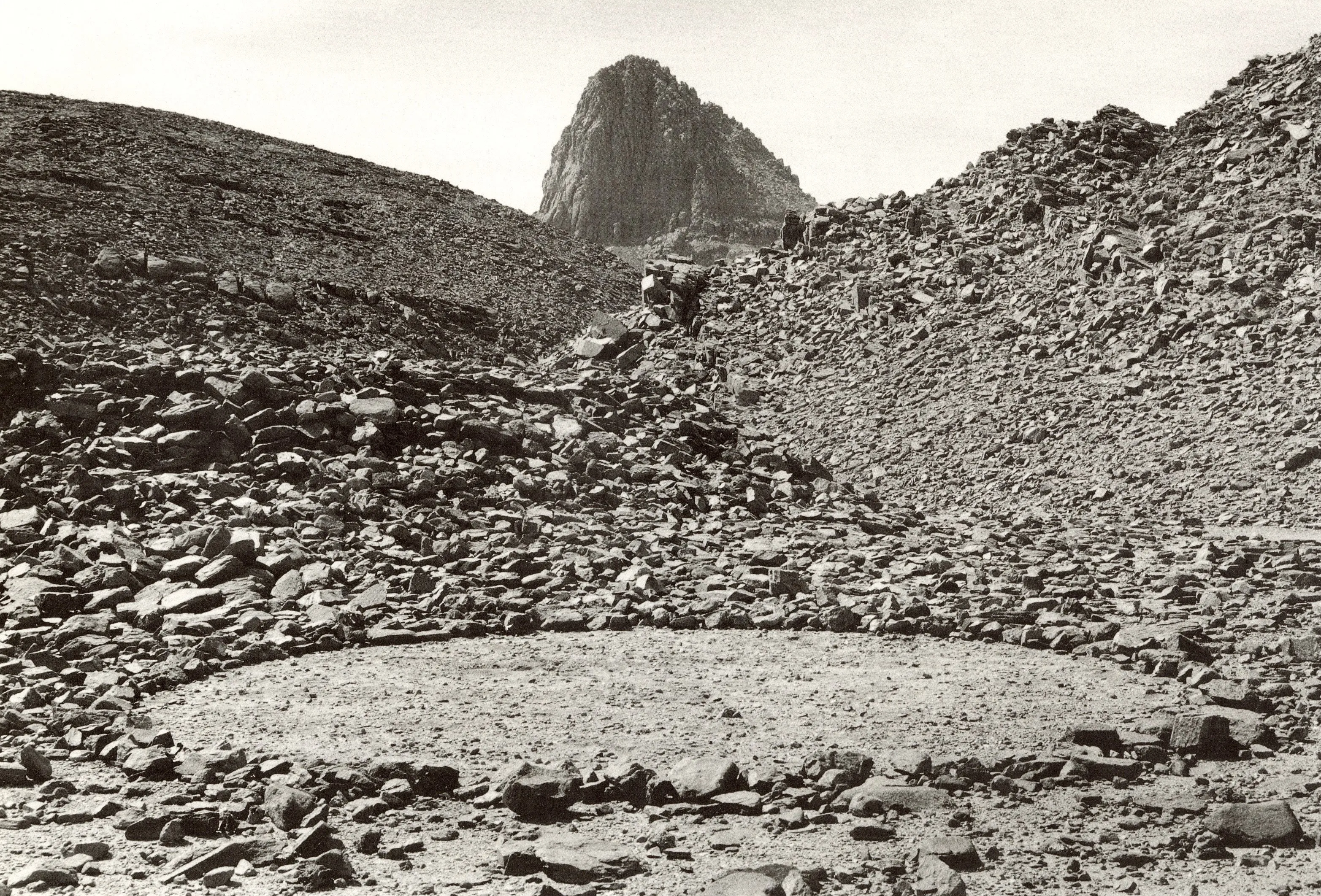
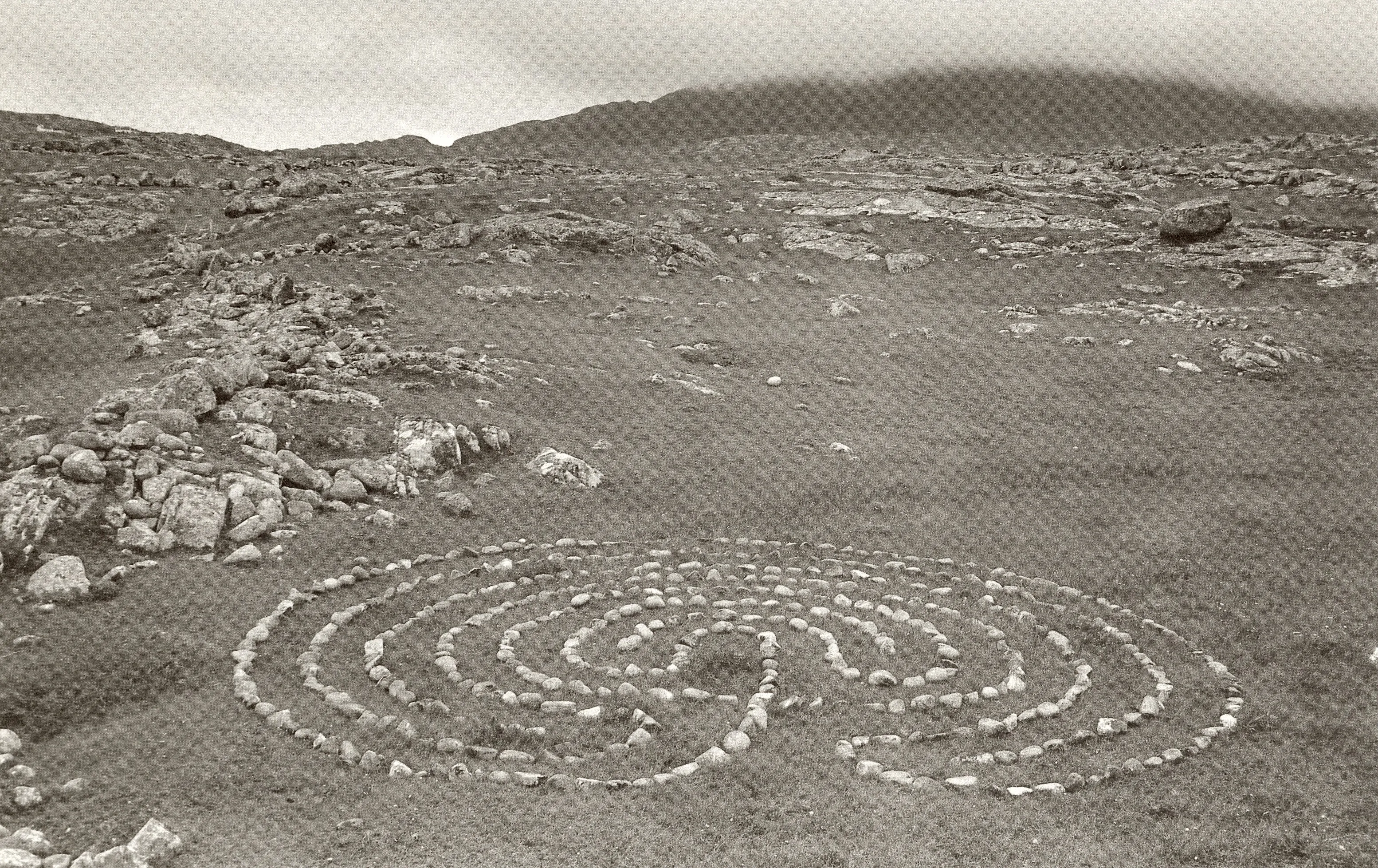
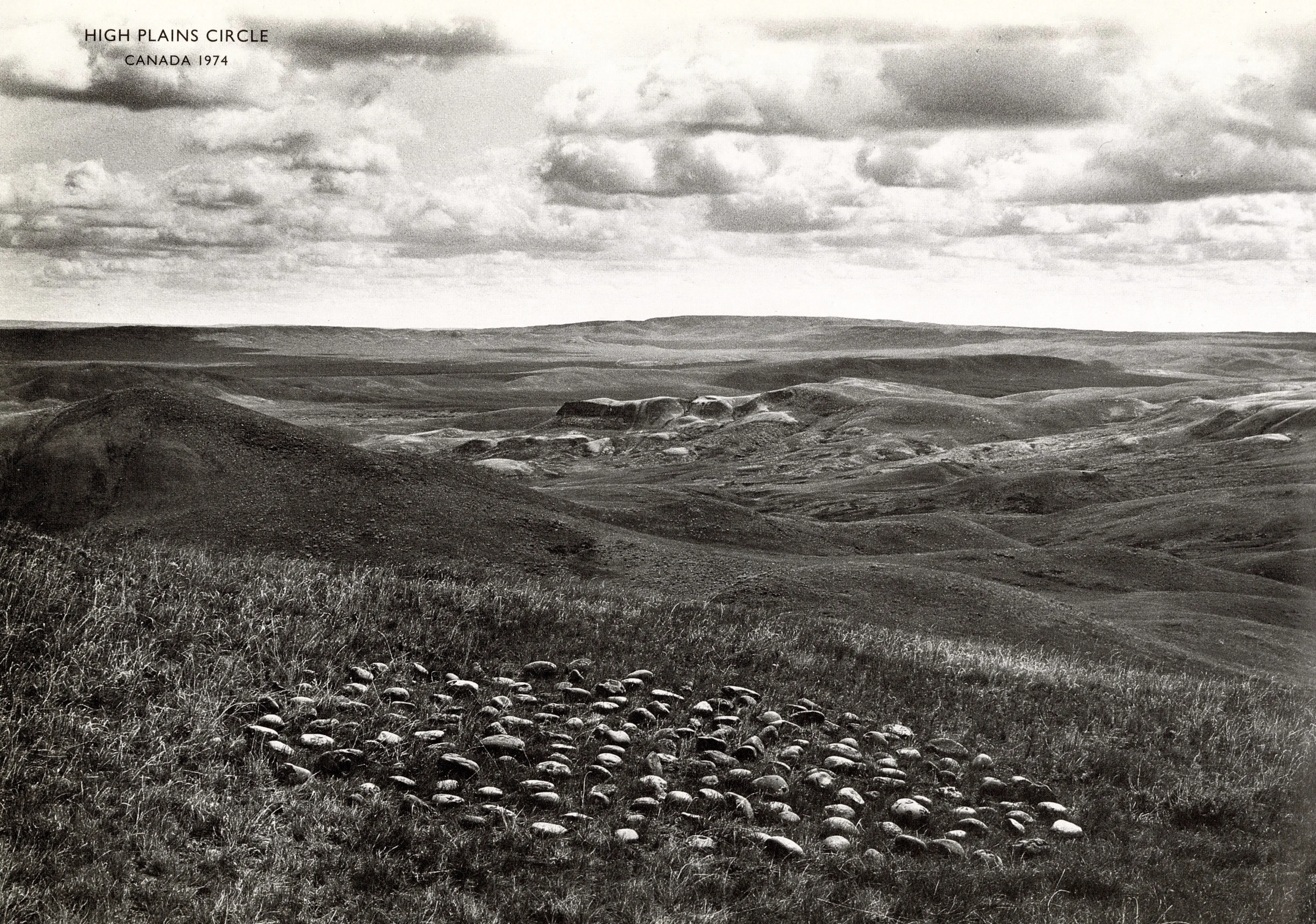
After spending more time with the work and reading what others have said about it, I giggle when re-reading my first thoughts. I now see that his walks are actually the feeder of his work. Without the walk through the landscape, without taking the time to learn about the landscape, being in it, Long’s senses could’ve never picked up on the intrinsic characteristics of that place, and he would have never created this sculpture. The Connemara sculpture (fig 6) would not have the same effect on us if it was in the high plains of Canada (fig 4). It is because he truly engages with the landscape, looks for previous marks of human beings, that he is able to make his works. The formal sculpture does not exist without the walk, because the walk has generated the context, the intellectual content and the form itself of the work.
Nature is sublime: early landscape photography
As mentioned above, at first I was more attracted to the visual form of Longs’ work, captured in these beautiful black and white photographs. Thank you very much algorithms, as I have been fed with lots of blacks and white photographs of landscapes in the past years. One characteristic that they all have in common is that often, nature is conveyed as the sublime.
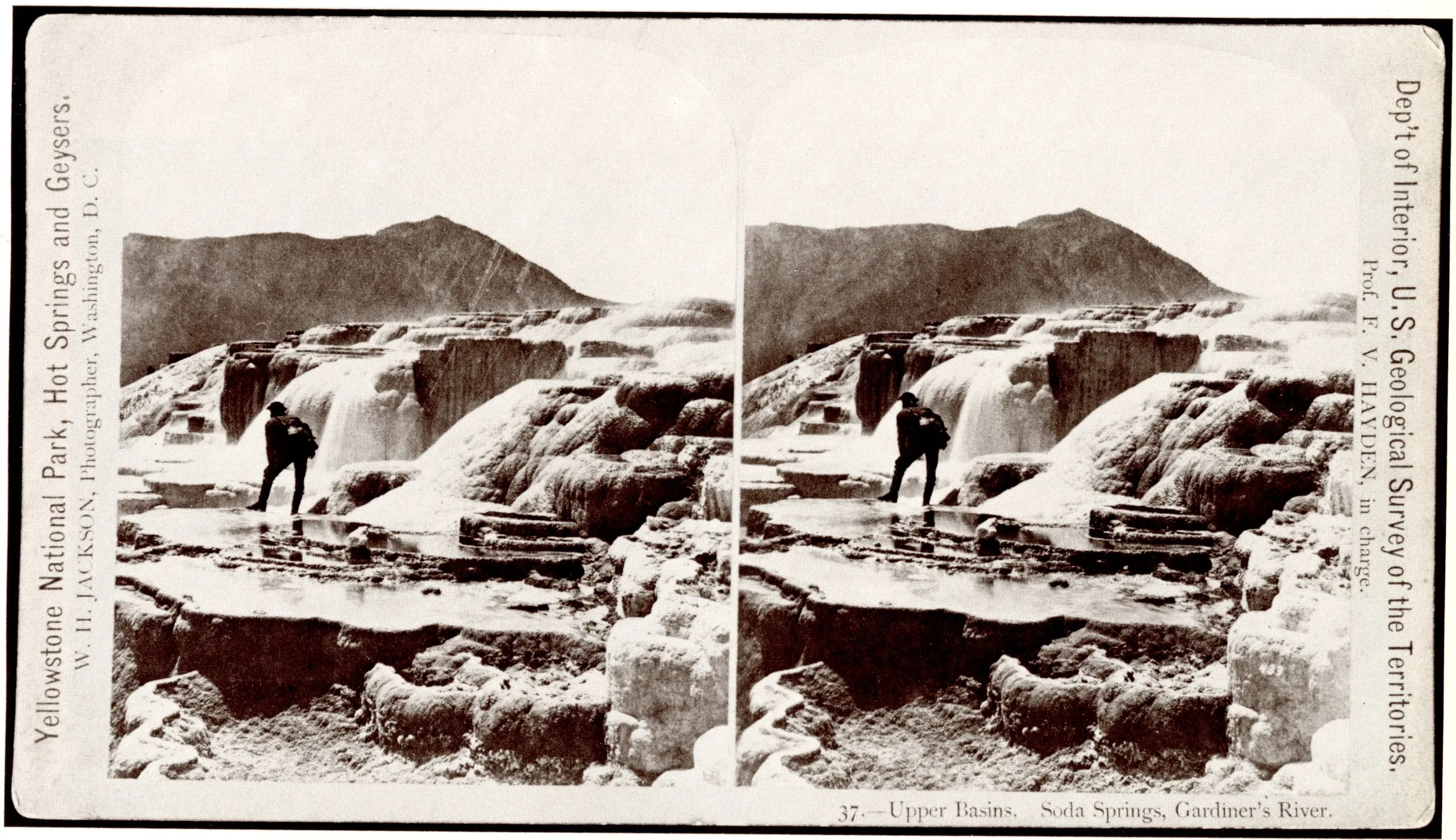
One particular movement that is interesting is the early photography of colonisers ‘surveying’ the wide landscapes of the West05. Catching these majestic scenes for the first time, in these photographs you feel the sense of awe, of discovery, of the greatness of nature and the smallness of humans. But pictures like the ones of William H Jackson now lack an awareness of the ephemeral and fragile qualities that are also present in these wide scenes. Nature is conquerable for the mighty human being (fig 07, 08).
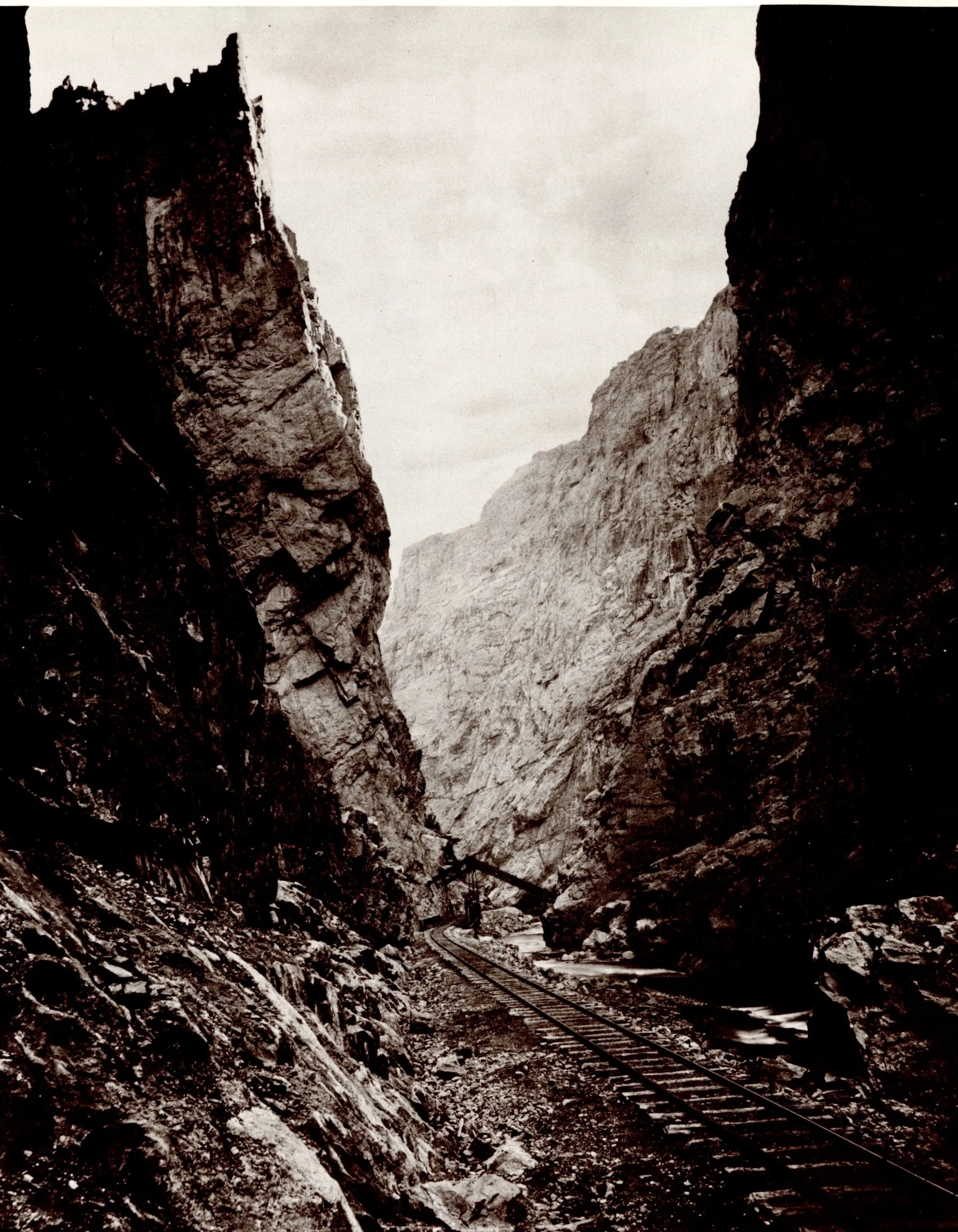
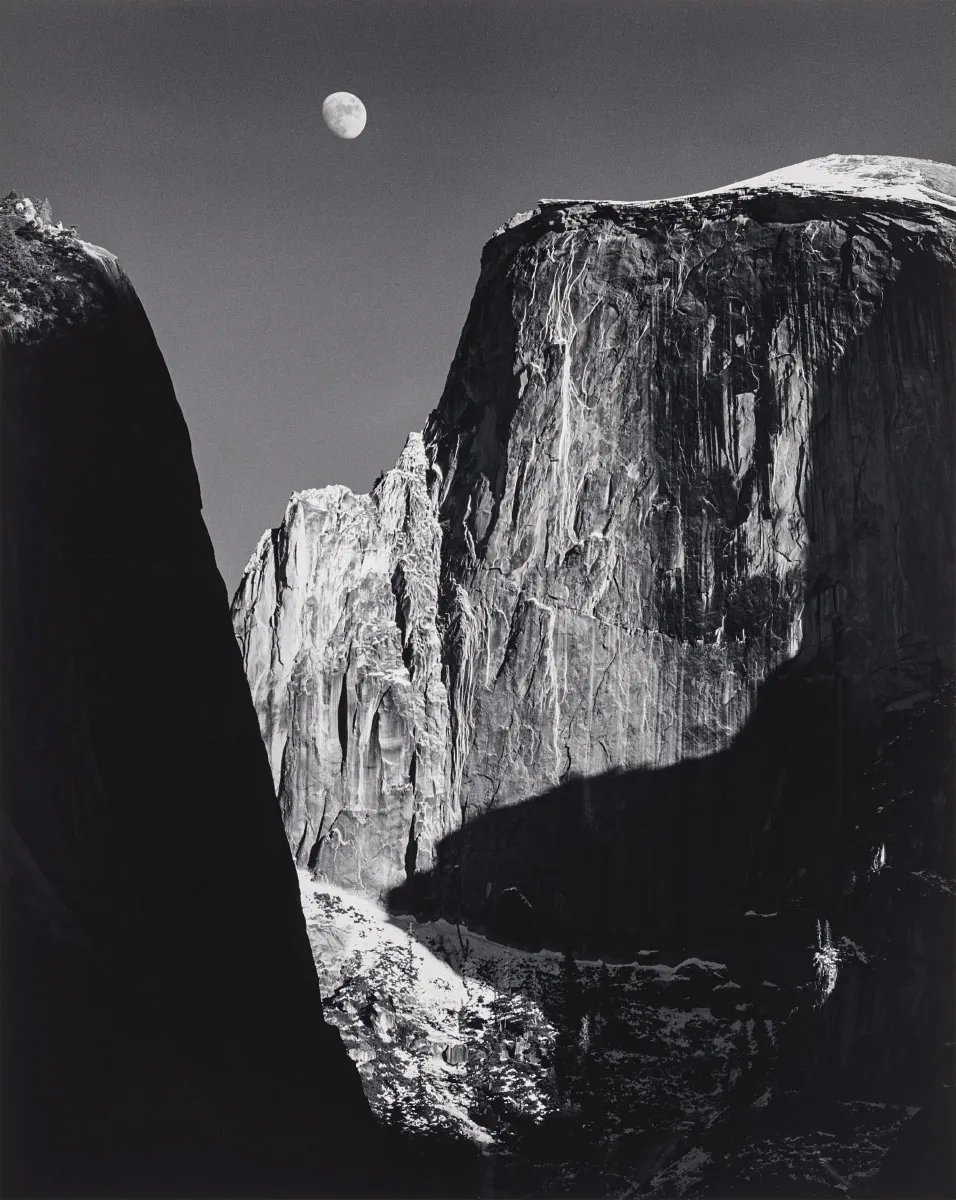
In a second wave, around 1960 (around Long’s time) the tone has shifted. These black and white pictures, quite often daunting, very dramatic, give you a sense of the sublime06. In these photographs, there is no trace of a human interaction. As John Szarkowski writes beautifully about the work of Ansel Adams (Fig 09): ‘his photographs stir our memory of what it was like to be alone in an untouched world’.07
These pictures instil in us a sense of beauty, scale, the power of nature. Richard Long also experiences these forces when he goes on walks through landscapes. But he is interested in more. He is interested in the human interactions with these landscape, and in time. Instead of one single photograph of a moment, he wants his art to be part of a long line of human actions in this particular landscape08. By making his walks, spending time in the landscape,or moving stones in them, he adds to the layers of time and place.
Andy Goldsworthy and an ‘English’ approach to nature


I find the human interaction with nature more interesting than just capturing it’s beauty and sublimity. Charles Harrison remarks: “There is a particularly English kind of nostalgia which we associate with such journeys and the resulting travelogues. It is a mood which can be identified with aspects of certain traditions, most of them insular and most of them literary at best involving a rare blend of original imagination and acute educated observation.”09 This sensation is also very present in the early works of Andy Goldsworthy. Born 10 years after Long, but also English, they share this English, pastoral10 sensibility.



The throwing series (fig 12-14) is an interesting example. So simple, sprung from ‘original imagination’, but making us reflect on the basic forces active in this world. By doing so the works are prone to be read as conceptual, becoming intellectual, a misreading Long has fought many times.11
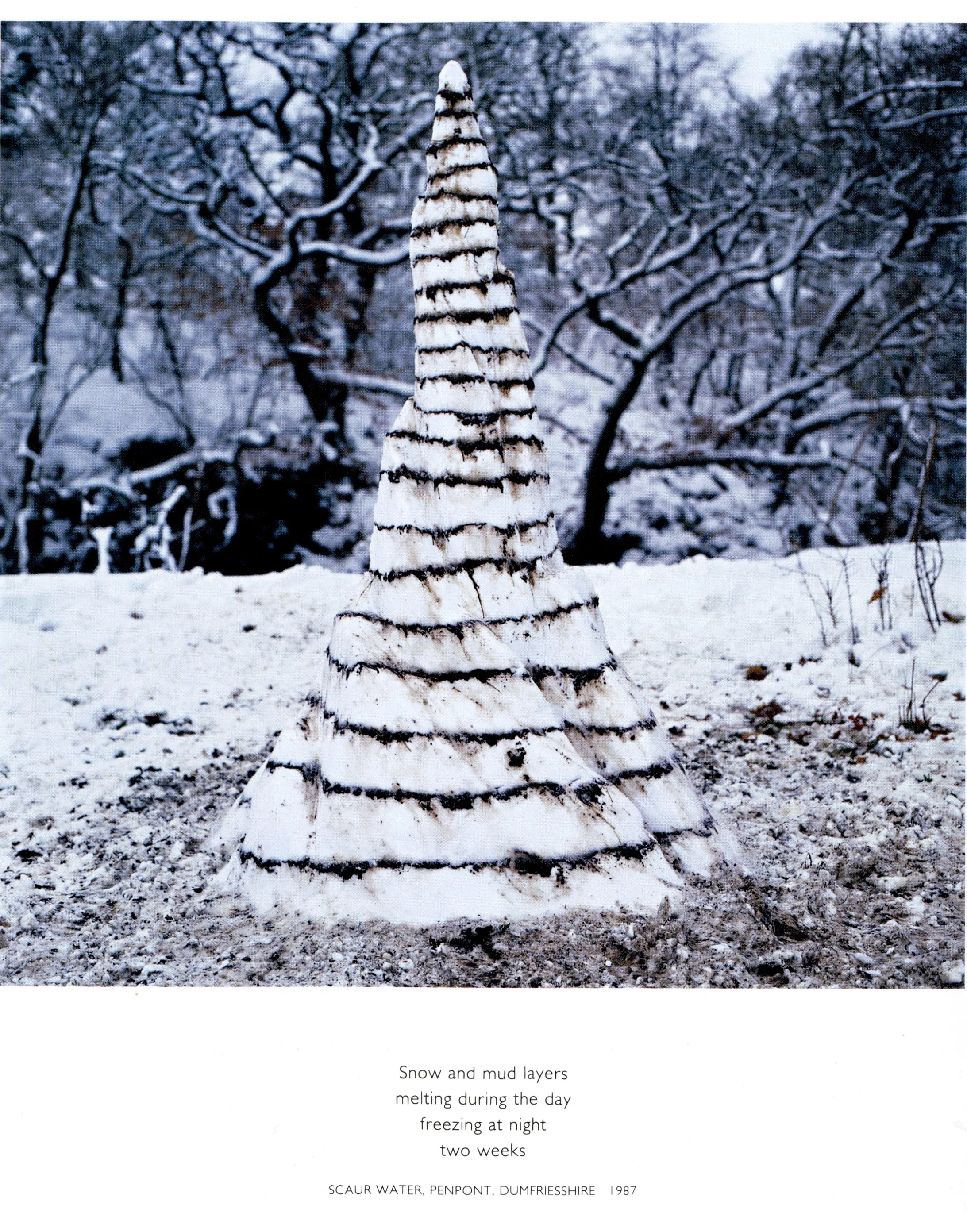
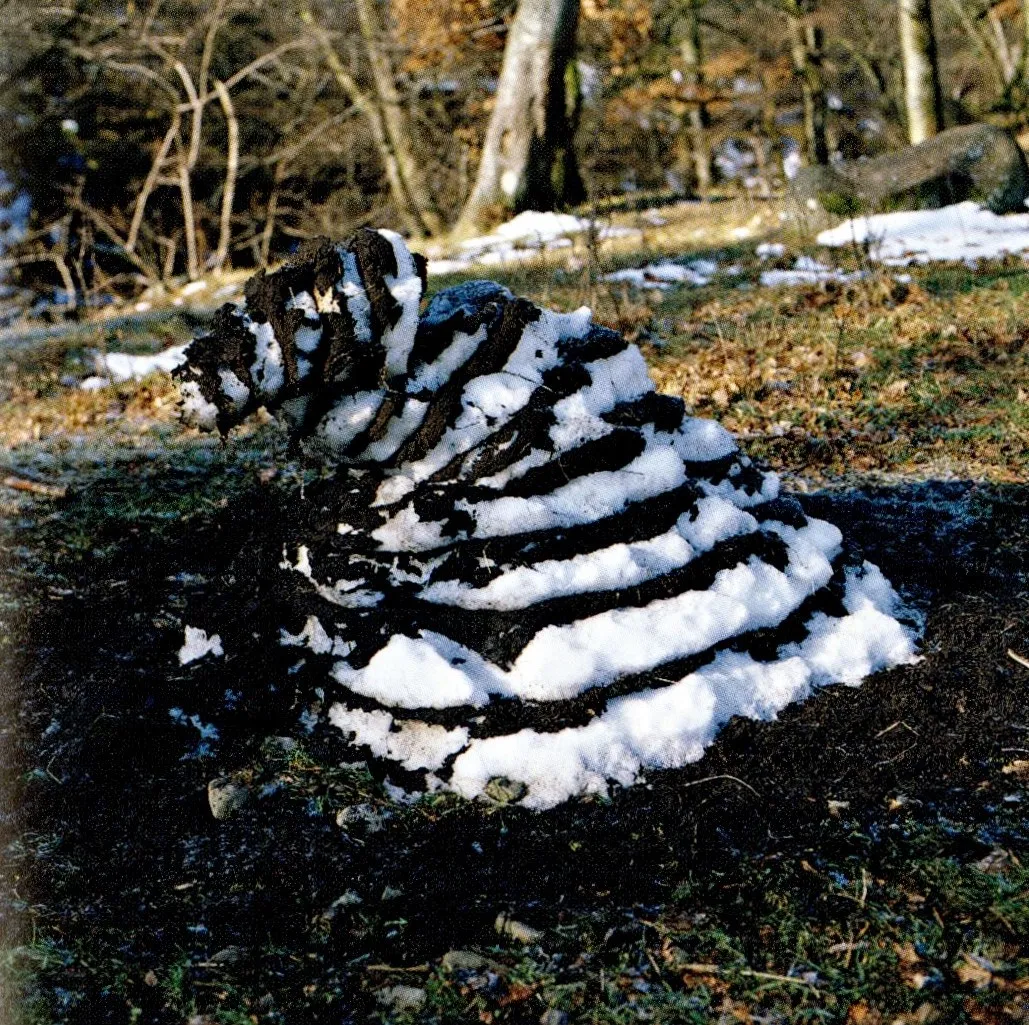
Another work that I find very strong is 1987’s Snow and mud layers (fig 15). Maybe this ‘Englishness’ lies in the poeticising of murky, grey, everyday evidences.
Tony Cragg and ‘thinking’ drawings
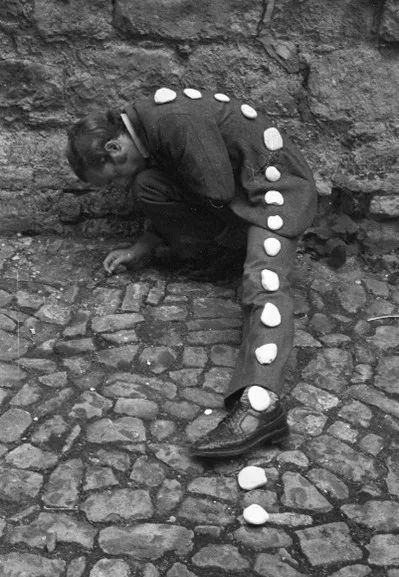
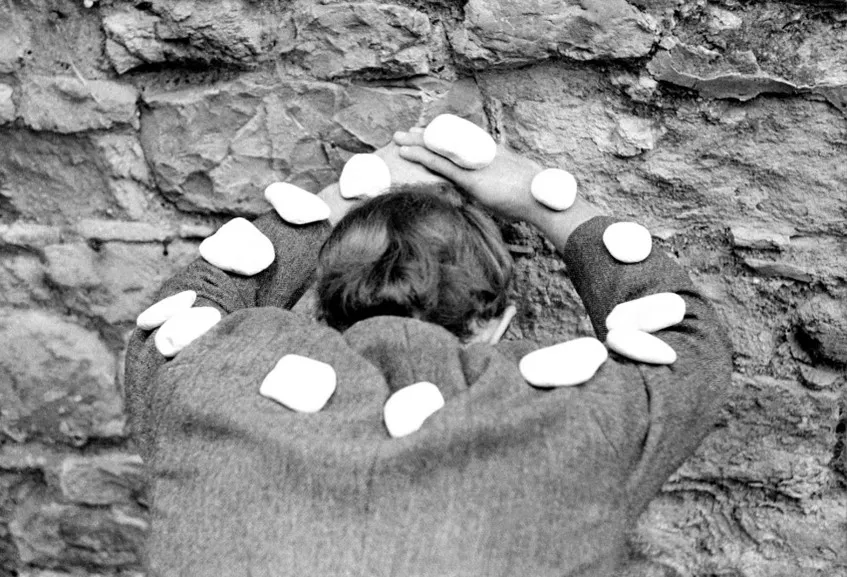
From what seems a similar starting point to Long and Goldsworthy, Tony Cragg’s work is about other things. Having been a scientist before becoming an artist, he is concerned with materials at a molecular level and is intrigued by how the world is made. He wants to challenge opposites and is concerned with the man-made-natural division of materials in our world12. His work becomes quite intellectual, and he loses me where when he leaves nature and starts working with plastics.
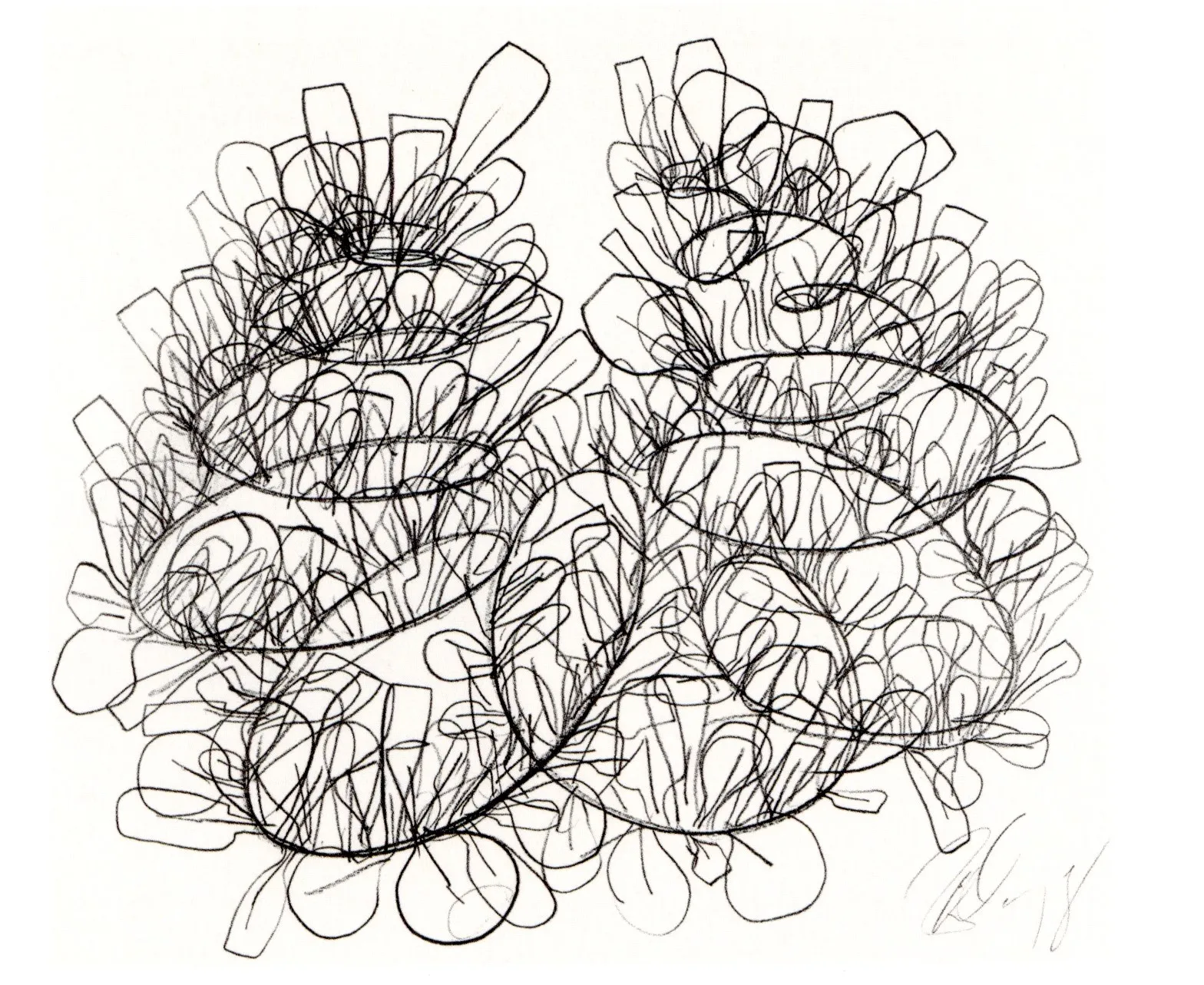
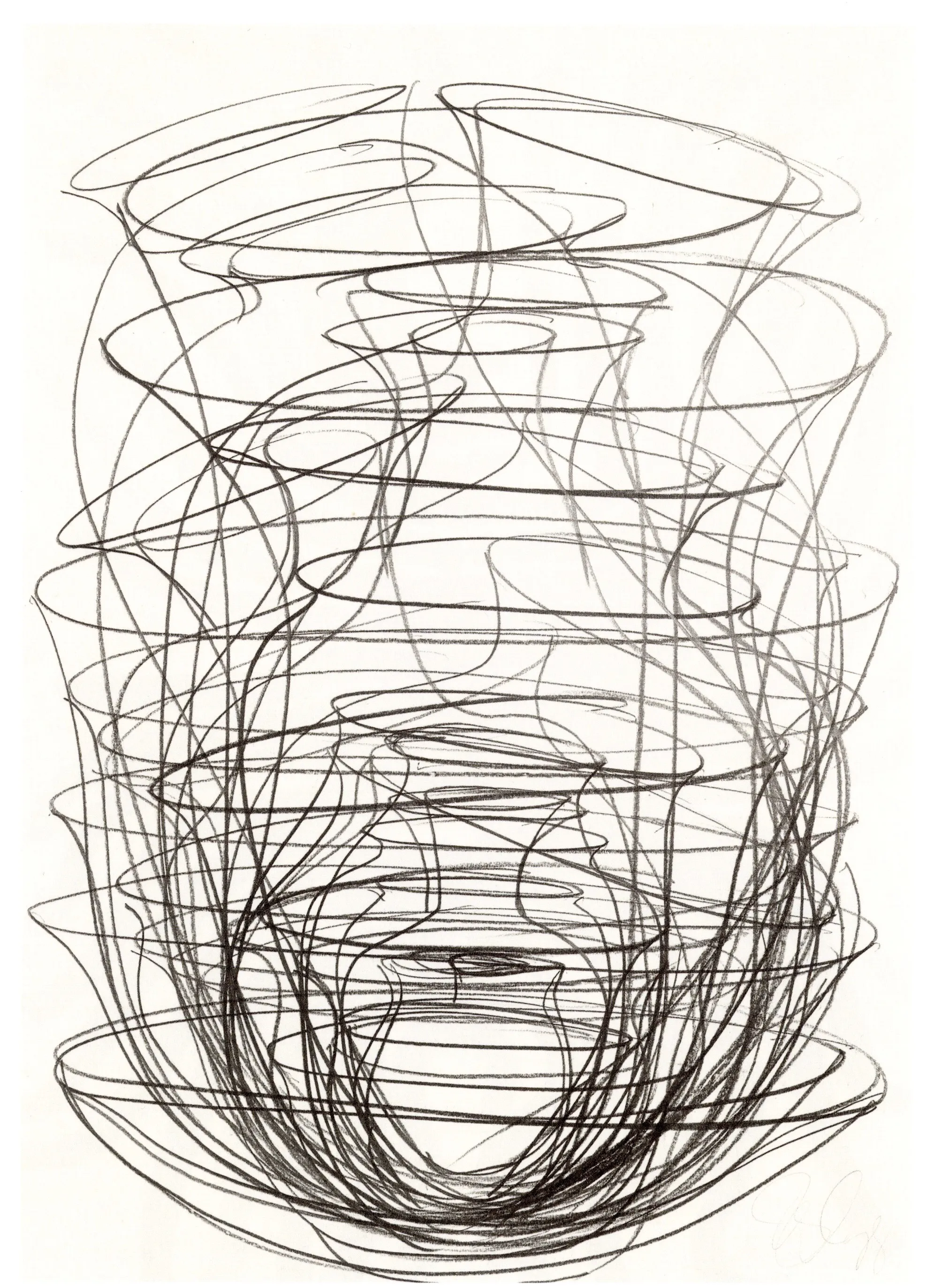
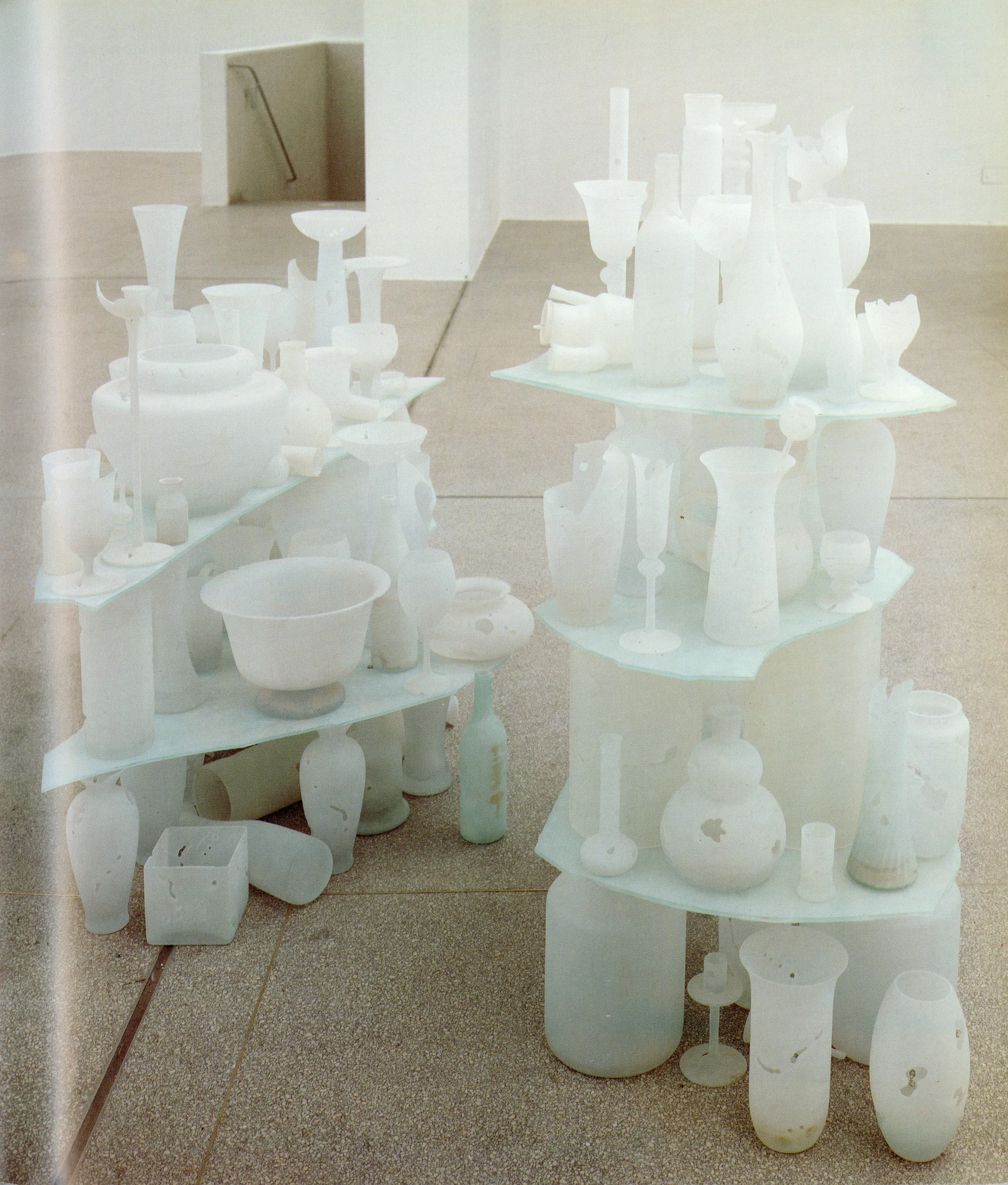
His drawings, however, are relevant for me. These are not presentation drawings, but ‘thinking’ drawings: fast drawings where ideas are explored, where technical aspects are thought through. The early ones often in very straightforward media like pencil, and very recognisable when you’ve seen the completed sculpture (fig 18, 20). But in 1988 Cragg also started exploring two dimensional works in its own right: “Cragg’s work in printmaking and drawing has emerged as an autonomous means of expression, an independent disciple which the artist regards as inexhaustible. In conversations with him, it is always clear that this work is not a stand-in for sculptures and that one cannot use the drawings to explain the sculptures. Rather, the artist used the medium as an instrument for visual thinking. “13
Rein Dufait, a new legacy?
Rein Dufait (born 1990) is a young Belgian artist. He dives into many of the themes the artists above have explored. As he is based in Ostend, by the Belgian seaside, his works often have a relation to sand.
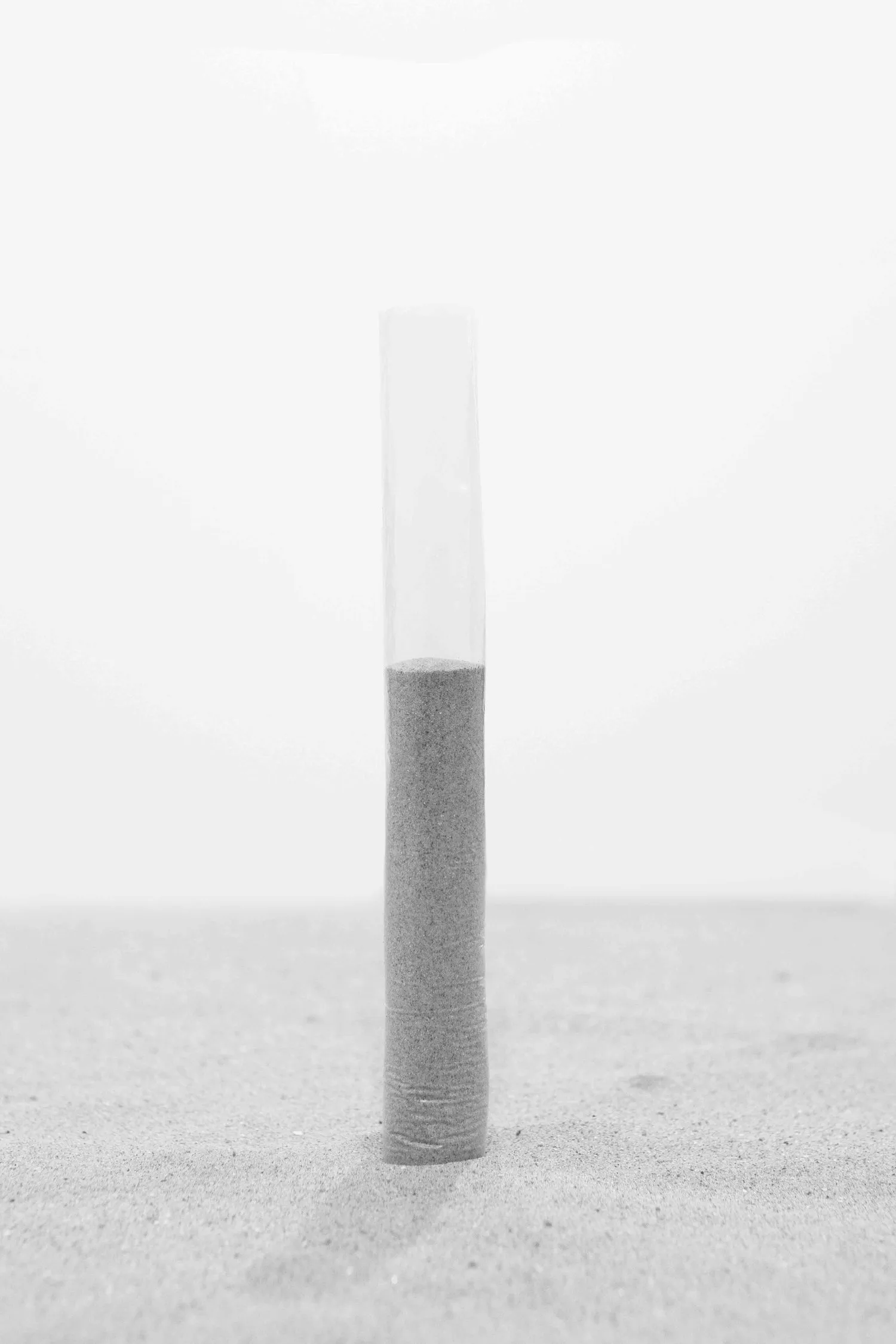
What Andy Goldsworthy did with by throwing things in the air, Rein does here with sand and plastic. It’s a revealing of something, I would say gravity and material properties in this case. These sculptures below14 (Fig 21, 22, 23) are like tiny experiments, where ‘sand tapestry’ is the most purified. Just a single square of see-through plastic on sand. The material is almost nothing on it’s own, and does nothing formally of structurally to the sand. But it does make you see the sand suddenly. The tiny square is a sand tapestry, and the sand around it isn’t. The gesture is similar to Nancy Holt’s Sun Tunnels15 but the relationship between the two materials used is more poetic.

.webp)

In 2016 Rein Dufait makes ‘Malkolos’ (Fig 24). A very simple idea: making a kind of endless column, where its shape is defined by the material used (one could say an homage to Brancusi’s ‘Infinite column’16). The material that is supposed to be the mould, is absorbed by the material of the sculpture, and by this becomes as much part of the sculpture as everything else. I like the honesty of this sculpture: the bulging out of the cardboard boxes because they cannot hold the weight nor stand the wetness of the concrete, the expressiveness and messiness of the thick ropes trying to hold everything together, creating the composition and aesthetic. Not a single thing is extra here, there is no afterthought. The material is the sculpture.
"The work is present as a 'cultural form' in the midst of other man-made shapes and the continuously evolving natural environment. Cement (earth, soil) and water (sea, rain) form the mortar. Oxygen(air) engenders an interplay. Even ossified, this ‘form’ remains a natural product. The rain introduces organisms, the wind sows moss, leaves turn to humus. Even after the artist is no longer involved, this sculpture continues to grow.”16
Joris D’hooghe said about Reins work that he makes ‘beelden’,17a word which translates from Dutch into ‘visual’ or ‘image’. It’s interesting that in Dutch ‘stand-beeld’, literally translates to standing-image, which would mean sculpture in English. As I’m exploring the relationship between the sculpture and the image of the sculpture in my practise, this etymological explanation gives comfort. One doesn’t have to treat them as two opposites or two different practises, but can embrace them as intrinsically belonging together.
Paul Coldwell on drawing
Drawing reflections seminar, autumn 2022
As part of the lecture series of the MA Fine Art Pathway Drawing, we have a few lectures that focus specifically on drawing. In this text I’ll point towards certain methods of drawing that were highlighted in a lecture by professor Paul Coldwell in the lecture theatre at UAL Camberwell autumn 2022, and I’ll critically reflect on these methods in relation the artist’s practise.In Paul’s lecture he brought forward various artists who use drawing extensively in their practise.
He talked about Marlene Dumas, whose drawings are almost just the moving around of material on the page. There is a very loose association between looseness and control. Her work is not about a meticulous detail but about a highlighted human expression. The looseness and the pace which her media and her method allow her to work, create an opportunity for ‘chance’ to happen. When the exact feeling she is after appears through this chance, it is even more powerful.
Another artist he talked about it Kiki Smith. She is a sculptor and approaches the sheet of paper as a material to build with, with texture that is as important as the drawing itself. She makes enormous drawings of stories with human bodies and animals. Usually there is something furry or hairy in her drawings. She likes spending time with a drawing and works with print regularly. Printmaking, she says, (talking about etching) allows her to keep her line very hard, very precise: 'it's a cut, not a bumpy line'.01 This helps her to achieve a visceral response when you come close to one of her drawings, and almost feel the fur through the dense marks. She is very aware of the paper she chooses, never one big smooth sheet but many glued together and full of ripples and when you get close, again, she is able to convey a sense of real human skin colliding with her image of the naked body, through this creaked, soft, yellow, flawed paper. The techniques and materials chosen help her to create work that is not just a flat drawing, but a sculptural object.
Both artists have found a medium and method that suits perfectly to their subject, and even elevates it to a higher level.
Rosalind Davis
Surviving and Thriving as an Artist
Professional Toolkit talk, autumn 2022
Rosalind Davis is an artist, curator, writer and gallerist who came to UAL Camberwell in autumns 2022 to talk about her book ‘What they didn’t teach you in art school’01. This book sits within a field of books that talk about the more practical side of being an artist. I’ll discuss the rise of this type of books in the art world, their message, relevance and relevance to young practitioners.
Recently I read two other books that sit within this ‘self-help’ category (according to amazon): How to navigate the art world, by Delphian gallery 02, and ‘How to become a successful artist’, by Marcus Resh03, published by Phaidon. First of all I have to say, it’s refreshing to read about the ‘business’ side of art as it’s not often talked about in school or even amongst artists. However, the first eagerness quickly turned into a murky moodiness, a total disappearing of the much needed naivety that is necessary to keep going in this quite complicated professional field.
It is quite revealing, and a bit painful, that many of the issues04 discussed in these books, are symptoms of a more global system/(art?)market, that is obviously flawed and being controlled by a very small percentage of people active in the field. I find it ironic to call it upon artists individually, to put in the extra mile and read these books to ‘help themselves’. 05 Nevertheless, I do want to be a professional (and successful?) artist, and I do understand the capitalist mechanics of this society in general, so I would rather be prepared for this profession and have all the extra tips and knowledge I possibly can get. Apart from some depressing figures about the amount of artists that can actually live of their art, I mostly remember that networking is extremely important, as is being on top of your admin. I also have a clearer view now of the art world in its entirety, as an eco-system with artists, gallerists, collectors, curators, writers and critics.
These books, as well as Rosalind’s talk, definitely help create a more realistic image of what it is like to be an artist and your own role in your career. I believe through media and films, the artist has been portrayed as a creative genius who is discovered by curators and gallerists. Artists never really benefit from this type of romanticized and outdated image. You need to be extremely proactive and make your own career happen. Especially as a woman! Rosalind closed of her lecture by saying: Always smile, and just be kind to people. And be true to yourself and your art. That’s a very positive and soft message, that I’ll gladly take on as advice!
01 Davis, R. and Tilley, A. (2016) What they didn’t teach you in art school: what you need to know to survive as an artist. London: Ilex.
02 Murphy, B., Thompson, N.J. and Delphian Gallery (eds) (2020) Navigating The Art World: Professional Practice for the Early Career Artist. 2nd Edition. London: Foolscap Editions.
03 Resch, M. (2021) How to become a successful artist. London ; New York: Phaidon Press.
04 Issuesthat made me moody: the power structures, the gatekeepers, the percentage of women exhibiting works, the different types of collectors (and mostly the ones that participate in flipping), and most of all the graphic with data that showed that if you don’t make it to a bigger gallery by a certain stage in your career, you’re very unlikely to make that jump later. Realising that only the top artists who are represented by the big galleries make enough money to live a sustainable life, this puts an enormous pressure on the now, on the beginnings of ones career, which is already difficult enough to make sense of!
05 I notice a tendency around me in creative fields, where individuals are encouraged to take matters in their own hands, as ‘you can do it yourself’, and it's very 'empowering'. This is probably fuelled by the power and accessibility of social media, which makes it possible for anyone to build up a media presence that can eventually lead to getting jobs, or a foot in the field one would like to build a career in. Although I totally agree that media presence and perception is very important, there are still ceilings one hits, doors that are closed and guarded by people with power. I feel that by using this strategy to make young people believe they can do it all themselves(often leading to very high levels of stress, hard work and loss of energy,burn-outs eventually), the responsibility of the ‘gatekeepers’ and people in power to include more young emerging artists, POC, women in their circles gets completely put down to the individual.
Kira Freije
Post-graduate lecture series, autumn 2022
Kira graduated in 2016 from the RA schools. She has exhibited around London and in Europe, and works mostly in sculpture. She came to UAL Camberwell to talk abou ther work in autumn 2022. I will reflect on her career path so far in the London arts-scene.
Kira is what one would call an emerging artist: she went to a highly ranked school for her MA in sculpture, and has since then been able to sustain a studio practise, participate in group shows at interesting artist-led gallery spaces, and is now also represented by the approach, a taste-making gallery within the London scene. She works in metal, which she welds, and with which she is able to create three dimensional sculptures in a relative fast and affordable way. Her titles are extremely poetic, and elevate her work to another level. Sometimes she would collaborate with writers, to get inspiration, or she would read poetry. This all contributes to a body of work that feels very authentic, very genuine, and very original. True to herself! 01
This all seems to be in place for promising career, so I’m quite curious to see what her next steps will be. If I could do a guess, I would think she could soon appear in a Talk Art podcast, or maybe on Katy Hessel’s Instagram? ;)
01 This was her final advice to all of us!